
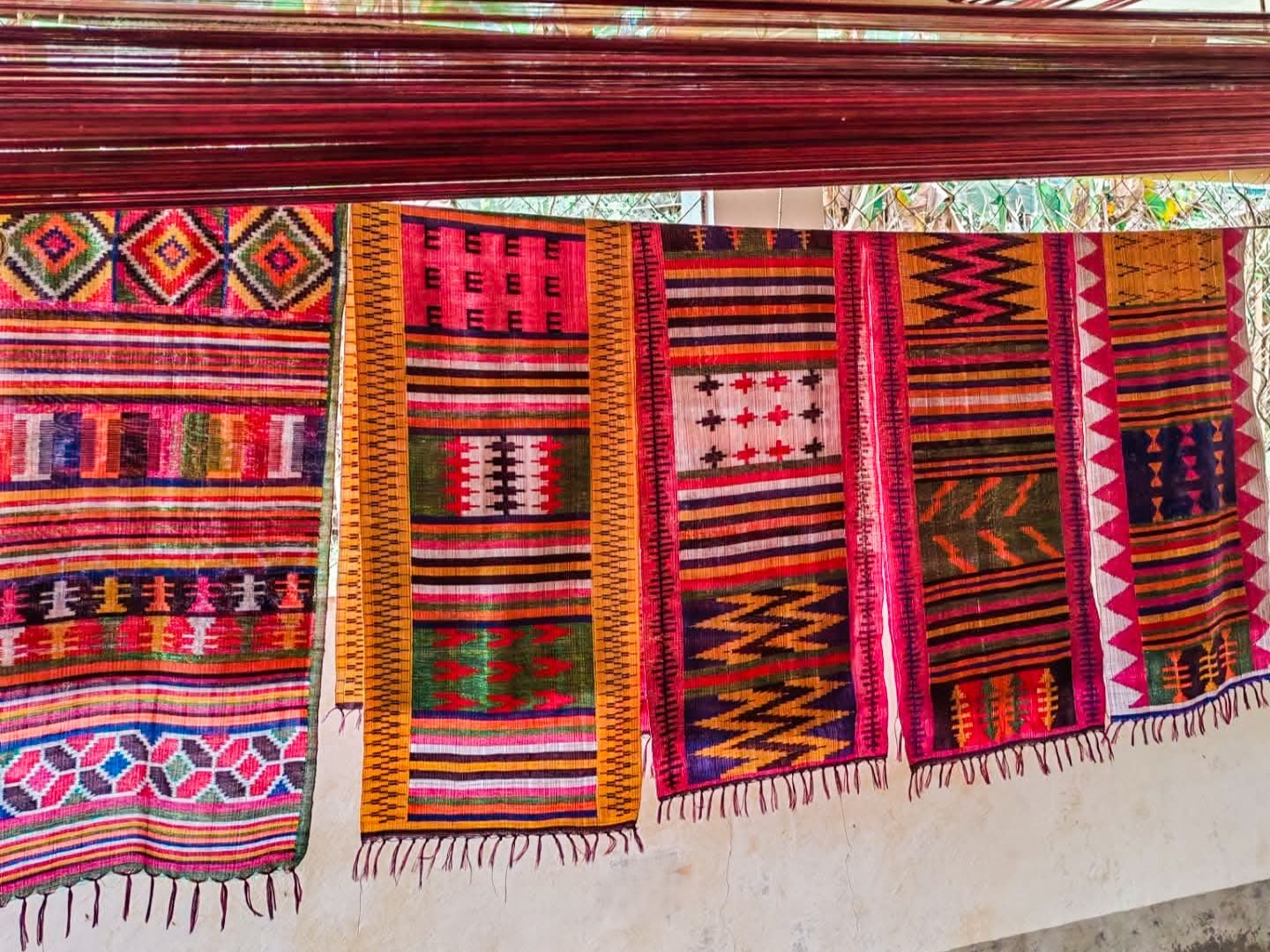
The Tausug people are indubitably known as fierce warriors in the battlefield. They have effectively won historical wars: from repelling invasion of the Majahapit Empire during their pre–Islamic history as Lupah Sug to their supposed assistance during the Bruneian Civil War during the time of the Sulu Sultanate. Their fearsome reputation in battle extended to the colonial period, so much so that the Spaniards and eventually the Americans have a term for the Moro swordsman from Sulu: the juramentado.
The honor that a Tausug warrior brings to the community is celebrated, so much so that their renowned traditional clothing, the pis syabit, is also used as symbol of a warrior’s notability and identity. As for us, we had the honor and privilege to have witnessed how the pis syabit is being traditionally made.


Livelihood Hablon Center in Parang, Sulu where the pis syabit is being made.
Pis syabit is the traditional tapestry of the Tausug that is often used as a head covering, known for its intricate geometric patterns and colorful designs. Its name refers both to the design and means in creating the woven clothing: pis refers to the geometric patters and syabit refers to the hook and technique. Just like many indigenous traditions, the skill involved in creating the pis syabit is a rare find, and as such a livelihood center was founded in the town of Parang in Sulu in order to provide income while at the same time preserve such a rare and intricate art.
We arrived at the Livelihood Hablon Center around 10:30 AM, just when there were lady weavers working at their respective looms. It was our first time to actually see weavers at work, and it was not just normal work. Before our eyes was culture and tradition at work.


The tedious and complex process of weaving the pis syabit.
We learned in the weaving center that a piece of pis syabit would normally take months to finish owing to the craft’s inherent difficulty. I can only imagine that we were probably surrounded by years of weaving when we were in the center as there were a lot of finished products on display. Hanging all around us were many months of colorful and creative hard work of living artisans who, like the Tausug warriors, are vested with honor, not for fighting wars but for fighting the battle of continuing a much treasured culture and tradition in the midst of prospect for progress and modernization.


Criss-crossed colors of culture.


The Renegade Duo seeing firsthand a vibrant and living tradition.
Sulu is surely an island rich in history, tradition and culture, but is way too underrated when viewed as a part of the greater scheme of things. It is, however, rightfully a major contributor in whatever the Filipino identity stands for today: resilient and enduring, dynamic yet inviolable. It deserves more, especially in terms of growth and development. The Tausug should be given more reasons to believe that ceding their sovereignty that made them to eventually be a part of the Philippines was not an exercise in futility.

Leave a Reply