
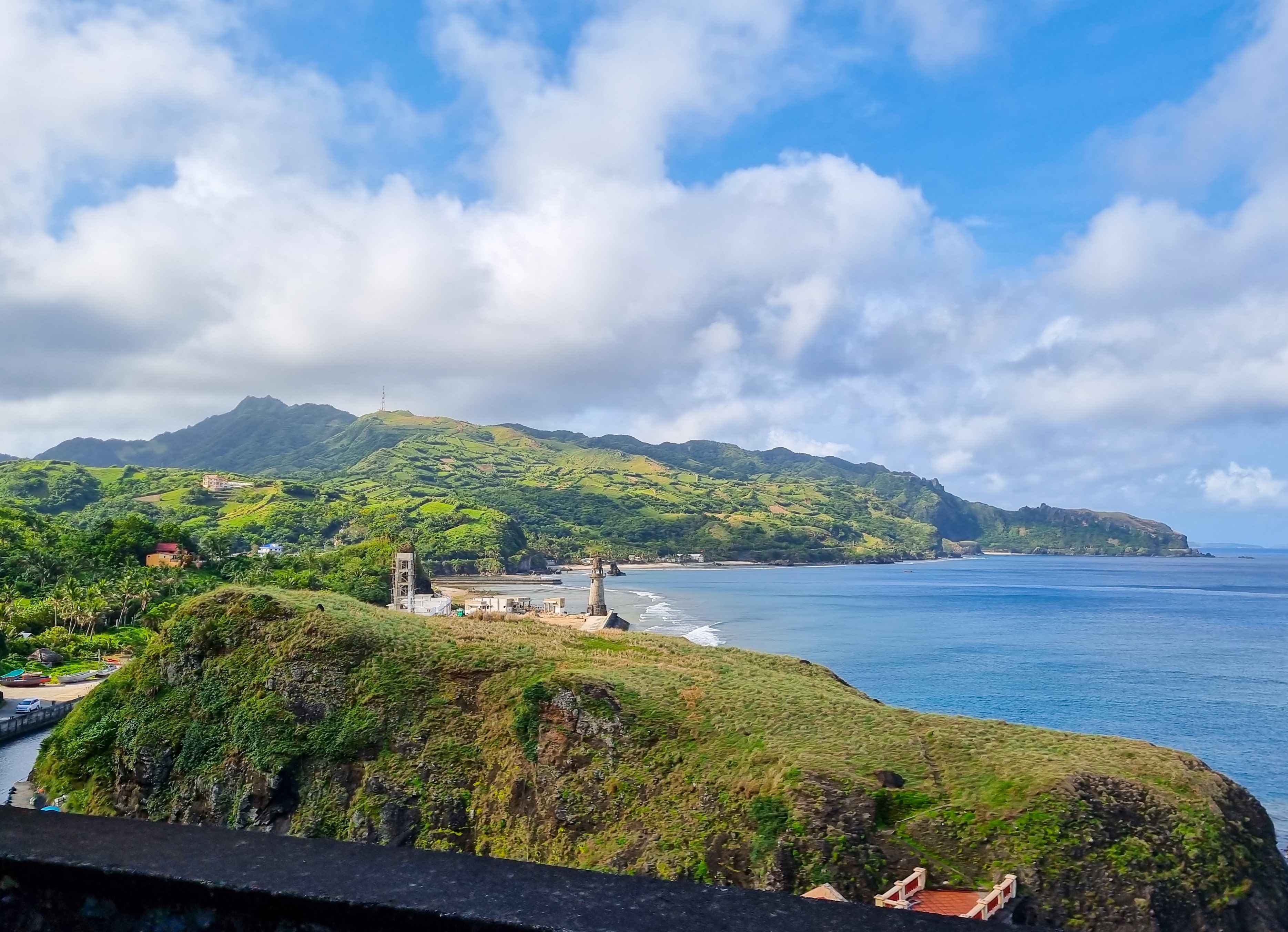
A little less than a quarter of an hour more from our stop in Chawa View Deck and we were back in downtown Mahatao. The place was still quite familiar as we were there just that morning of the same day. We were cycling until we saw a lighthouse from a distance, with the floating island that we saw earlier that morning in the foreground. It was decided hence. We would go to that lighthouse.


Usually called Mahatao Lighthouse, an appellation that it shares with Tayid Lighthouse, the beacon located on the western coast of Mahatao is actually Busbusan lighthouse. Still uncompleted and with ongoing construction of establishments in its immediate vicinity when we visited, it is in a rather low location compared to other lighthouses in Batanes, such as the one in Basco which is located along the slopes of the hills.


The sun was behind the lighthouse during our visit, so we used the height of the lighthouse to our advantage so we would be able to take good photos.


We continued exploring the complex where the lighthouse is located, until we realized that it actually stands right within the complex of the Mahatao Boat Shelter. During our morning Mahatao Tour, Kuya Joaquin pointed to the boat shelter and told us that during typhoons, boats are kept in the shelter, away from potential destruction by the winds and the waves.

Mahataohatao Idjang, which rougly translates to floating hillfort settlement, is the landmass on the left side.
The weather just happened to be nice out when we were in Batanes, but apart from its beautiful sceneries and preserved cultural way of life, the island province is reputed to be the terminal passageway of typhoons passing through the Philippines. What happened to the PAGASA Radar Station in Tukon aptly gives a preview of how tempestuous the weather in the islands could be, hence the necessity of having the boat shelter.
The Ivatan ingenuity was clearly at work in the construction of the boat shelter, as they took advantage of the hills and of the floating island to provide a natural barrier that even strong waves could not topple.


After our mini-adventure in the boat shelter, we went on further to the heart of Mahatao until we finally reached the town center. It was around 03:40 PM, and Ran and I went to the food stalls located in the town plaza beside the Mahatao Church and fronting Mahatao Elementary School.


We just rested for a while, relaxing with the laidback vibe of the far-flung island province, watching kids play under the afternoon sun and adults chat under the shade of the trees. Such a dreamy afternoon.
We bought some snacks and bottled water to bring with us as we travel back to Basco. It would be roughly an hour going back, and we do not want the sun to set on us while we were on the road.


On our way back to Basco, we caught a glimpse of Mt. Iraya. It was such a pity though. Our second day in Batanes was already about to end, yet the majestic guardian of the Ivatan remains hidden under her blanket of clouds.


Our biking spree in Batanes, having visited natural and manmade wonders and having spent some time just observing people drove me into cogitation. Despite the usual battering that it receives from storms, Batanes remains an abode for the Ivatan and a coveted destination for travelers both locally and internationally. It is a gem, rightfully the crowning jewel of the Philippine Islands.
While the beauty of the islands is something that nature can preserve by itself when simply left alone, communities, cultures and values could only thrive and be preserved if people actually work together, and to do so while resiliently co-existing with the forces around them. The Ivatan has proven that such co-existence is possible, that’s why despite the centuries of wrath of the skies, they continue to consider the islands their home. They did not change what’s around them. They adjusted until what used to be an adjustment for self-preservation became a way of life. The beauty of Batanes hence is not only with its natural wonders. More to that, it is on how such wonders remain intact despite human presence.
Humanity is not antithetical to nature. For what it’s worth, the two complements each other. No doubt, the people of Batanes is doing a great job in showing us just that. The Ivatan is above and beyond in preserving the beauty of both nature and culture, but especially culture that despite being tested by tempests remains vibrant and thriving, ever ancient yet ever new.


Leave a Reply to renegadetravellerCancel reply