
The quest for adventure sometimes end up being synonymous with the quest for the extreme. No, not just extreme activities like taking on the reported highest canyon swing in the world, but being on places with extreme appellations. The Renegade Junctures duo would not want to lag behind: from being in the northernmost town of mainland Luzon that crosses the 39th parallel, to being on the end of all roads in Northern Luzon and seeing the last kilometer marker up north. Of course, who would want to forget our exploration to the last province in mainland Luzon that completed our mainland Luzon map, and our journey to the northernmost province of the country?
There definitely remains a lot more of places to explore in Luzon, but now is the time we go down south of the country. It’s about time we set foot in the land of promise, Mindanao. Zamboanga City was our chosen gateway to this land of beauty, often shrouded by mystery.
Our flight to Zamboanga City would not be until 01:35 PM, but we were already in the airport as early as 10:00 AM. Aviation in the Philippines tends to be crazy, and getting ahead is the best way to avoid potential hassles along the way. No more repeat of our Tuguegarao flight experience.


Thankfully, our flight was on time, and in more or less a couple of hours, we finally reached Zamboanga City, our first in Mindanao.
Zamboanga got its name from the Sinama word samboangan, literally place of mooring poles. This etymology makes sense given that as a peninsula, the place has port towns where vessels and ships can dock and moor, making Zamboanga an important hub for seafaring and trade. Its landmass protrusion cuts through the Celebes Sea, creating the Moro Gulf which is the biggest gulf in the Philippines.
Zamboanga Peninsula at large used to be a part of the historical Moro Province that existed between 1903 to 1914. Moro Province was large, somewhat comparable to the enormous old Mountain Province, encompassing five districts: Zamboanga, Sulu, Lanao, Cotabato and Davao. When the Moro Province was dissolved in 1914, the United States colonial agency Department of Mindanao and Sulu divided the territory of the former province into Zamboanga, Sulu, Agusan, Cotabato, Davao, and Surigao. The department was likewise eventually dissolved in 1920, and Zamboanga became a province of its own with its namesake town of Zamboanga as its capital.
The then town of Zamboanga was declared a chartered city in 1936. The capital of the old province however, was transferred to Dipolog during the Japanese invasion, then was transferred again to Molave after the war.
In 1952, the province was divided into two: Zamboanga del Norte and Zamboanga del Sur. The chartered city of Zamboanga was included in the territory of Zamboanga del Sur despite being governed independently from the province. In 2001, a third Zamboanga province was carved out from the territory of Zamboanga del Sur, which was named Zamboanga Sibugay. The formation of Zamboanga Sibugay caused the geographical separation of Zamboanga City from Zamboanga del Sur.
Despite being geographically separated and being designated as a highly urbanized city and as such independent from any provincial government, Zamboanga City remains considered part of Zamboanga del Sur for statistical purposes, and the former is still considered the largest city of the latter. They are historically and culturally tied after all. The same is true for all highly urbanized and independent chartered cities in the Philippines where they are clustered with the mother province where they are geographically located in and from which they were originally part of.

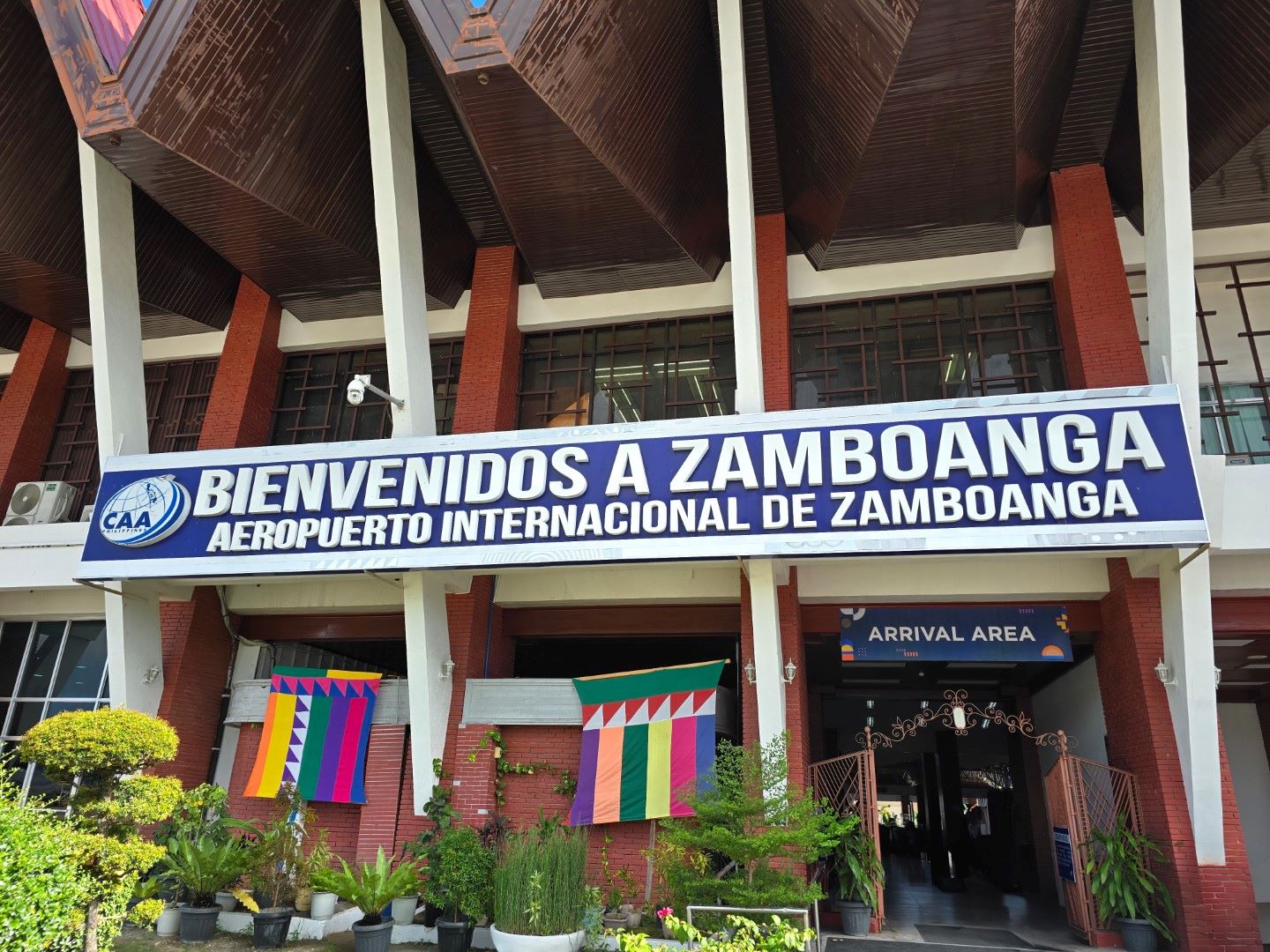
We landed in Zamboanga International Airport at around 03:30 PM. The city is known as the nation’s Latin City owing to Chavacano, its language which is a Spanish creole. Words are highly intertwined with that of Spanish, such that save for some variations, a Spanish speaker would understand a Chavacano speaker. This is very well true with the welcome signs that received us in the airport.


Looks Spanish, but no! It’s Chavacano!


Zamboanga International Airport from the front.
Upon exiting the airport, we took a little walk until we found a queue of Piaggios where we rode to our first stop. Taking a walk was intentional. Public transport vehicles waiting for passengers right in front of airports tend to overcharge, and we do not want that spoiling our first trip to Mindanao.

We booked and Airbnb for our first night in Zamboanga City, and the accommodation was our first destination. It was a quick stop though. We just checked-in, left our bags, and moved on our way to explore the city. On our way to downtown Zamboanga, we rode the traditional tricycle. Unlike the usual ones though, tricycles in Zamboanga are rather huge because of the distinctive windshield that sets it apart from other tricycles in the country.


It was a cozy slow ride along the roads of the Latin City on a hot afternoon. We were excited. There were a lot of firsts involved in this trip, and Zamboanga City is not our only destination in Mindanao. It is rather our stepping stone, the starting point to an extreme bidding: our goal to reach the southernmost provinces of the Philippines.
Tara! Samahan ninyo kami sa Lupang Pangako.

Leave a Reply to renegadetravellerCancel reply