
Ipatatapon kita sa Dapitan! When I was a young kid, I would often hear this phrase from adults. I will have you exiled to Dapitan. Back then, I did not even know where Dapitan was, let alone what it was. Later on, when I got to know and eventually fell in love with history, I finally grasped what being exiled to Dapitan meant.
Mr. Jose Rizal will be banished to one of the islands in the South. His conduct on this occasion will be judged as it deserves by every patriotic and Catholic Filipino, by every righteous conscience, by every sensitive heart.
Governor–General Eulogio Despujol, Decree of Banishment, 07 July 1892
On 17 July 1892, at around 07:00 PM, Jose P. Rizal arrived on the shores of Dapitan by virtue of a decree issued by Governor–General Eulogio Despujol. Rizal, among other things, had been accused of possessing published materials considered hostile against the Spanish Government and the friars, and for writing his two novels, Noli Me Tangere and El Filibusterismo, that are both critical of colonial Spain, with the latter dedicated to the GOMBURZA: three martyred priests Mariano Gomez, Jose Burgos, and Jacinto Zamora.


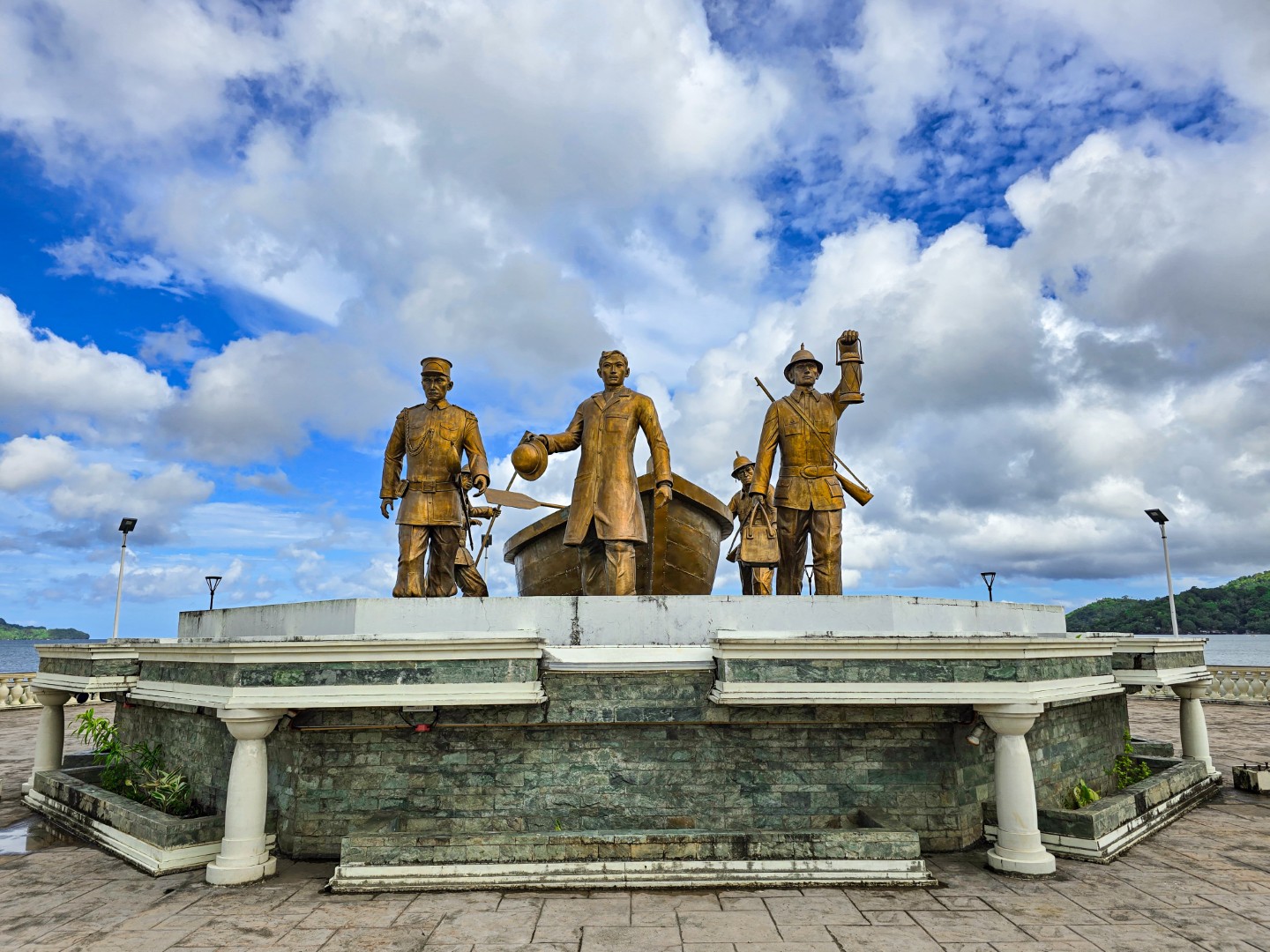
Monumento del Punto de Desembarco de Rizal en Dapitan.


The markers in the Punto de Desembarco: one is the historical marker and another commemorative for the monument’s construction.
A public park now stands where Rizal landed in Dapitan on that fateful night of 1892, and a monument stands in the middle of the park, a fitting way to memorialize the beginning of considerably one of the most productive and fruitful exiles that one may find in history. Despite being declared as an enemy of state by the Spanish Crown, Rizal was relatively free throughout the duration of his exile in Dapitan. There, he established a school for the local children, practiced medicine and built a clinic, and pursued scientific research. It was also during his exile that he would meet Josephine Bracken, his would-be widow.
Particularly aware of the historical significance of the place where we were standing, it should go without saying that we grabbed the opportunity to have our photos taken.


Souvenir photos of Ran and I before Rizal’s monument in Dapitan.
If one would look at it today, it would seem that Dapitan is not really a suitable place to banish someone, as it is a progressing city after all, ripe with infrastructure, tourism and commerce. One must not forget, however, that such was not the case in 1892. It was considered a very remote part of the archipelago back then, far from the center of of power of the colonial government. It was for that reason that the Spaniards thought that Dapitan would cut Rizal away from his sphere of influence, hoping to eventually break his spirit in the process.
They were wrong. They were very wrong.


The park of the Punto de Desembarco and its surrounding seascape.
Rizal’s exile in Dapitan could be best described as that moment where one turned a challenge into an opportunity. It was an exile, something that was designed to restrict him. He still managed, however, to move around and be a productive contributor to the social landscape of what was a remote town. Fast forward to the present day, Rizal’s contribution to Dapitan has been immortalized in every monument, historical marker and street name in the city now dubbed as the Shrine City of the Philippines. In fact, it goes beyond Dapitan, with Rizal being arguably an adopted son of the entire Zamboanga Peninsula.
Dapitan is said to have gotten its name from the Visayan word dapit, which means to invite. The name is somehow ironic for its reputation of being a place of exile, especially for one who is indubitably a very important Filipino who ever lived. That irony aside, Dapitan today is an inviting abode where a vital part of the nation’s history comes to life, making a living link between an exile in the past and a progressive view into the future.



Leave a Reply