
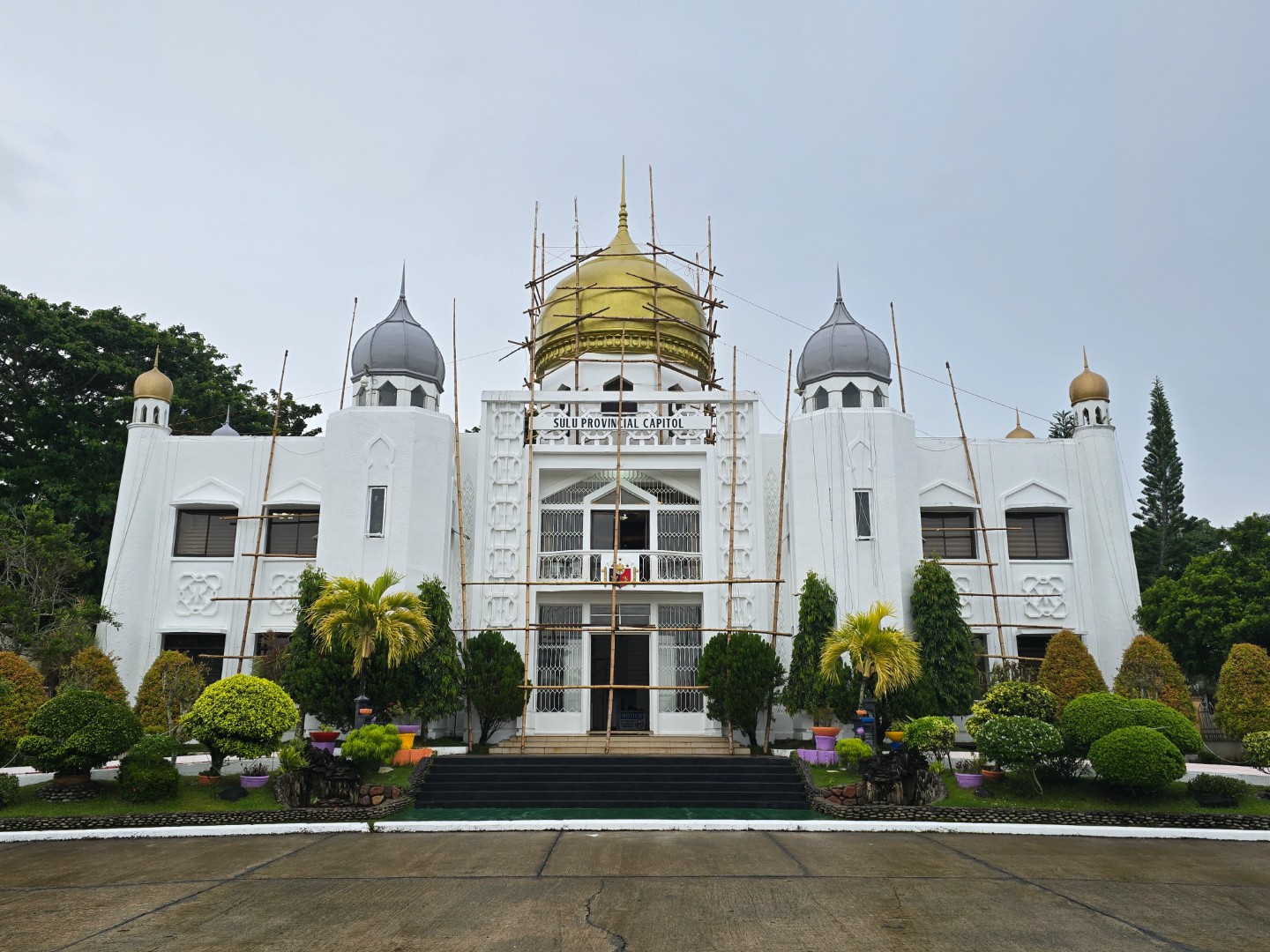
Visiting the provincial capitol of the places we go to seems to be an official rule for at least a couple of reasons. One, it is the seat of power of a province, conveniently situated at the capital city or town. Visiting it is hence practical, as provincial capitols are almost always surrounded by other points of interest and of centers of commerce. Two, there could be no better proof of being in a province by being in its capitol building. A visit to the capitol pretty much seals the deal.
Those are two reasons, and I did say at least two. It is way too much of a bonus if you visit the capitol of a province that is rich in history, so rich in fact that it has gone from being a principality to being a sultanate, and presently, a province of a sovereign nation.
The present structure of the Provincial Capitol of Sulu is credited to one of its former governors, Governor Murphy Sangkula who served from 1968 to 1975. Predominantly designed in Moorish style, the capitol features domes reminiscent of Islamic architecture, showing the enduring influence of Islam in the region, not only in terms of faith but more so in the way of life. Such design also speaks of its glorious past, a form of telling that this land remembers what it was.


The Provincial Capitol of Sulu.
The town of Jolo was designated as the capital of Sulu in 1914, when it was still part of the American Moro Province. During the Spanish Era, however, Jolo refers not only to the main island but to the entire Sulu archipelago. Originally spelled as Xoló by the Spaniards with the first letter pronounced with the vestigial ʃ or the sh sound, it evolved when the Spanish language transitioned from Middle Spanish to Modern Spanish where the first letter x was rendered with an h sound in most Spanish dialects. The term sulu, meanwhile, came from the Tausug sulug, an old form of sug, meaning current.

The capitol was undergoing repainting during our visit, but that did not hinder us from seeing the beauty of the structural design of the building and the cultural influence that it conveys. The bamboo scaffoldings did not also deter us from taking photos with the capitol building at the background.


The Renegade Duo at the capitol of Sulu.

Apart from the capitol building, we also took some photos in the I LOVE SULU signage, which one could tell is a rather new creation as the proliferation of similar signages in almost every town in the country is a fairly recent affair. Even without such a signage though, it was not hard to understand why one may almost immediately fall in love with Sulu, and we would be proven right as we went along our journey.


Loving Sulu at first sight.
Once we were done with all the picture taking, we started a short walk going to our next destination, which somehow proves my point number one in the opening paragraph of this entry. From having a preview of the richness of the history and culture of Sulu as enshrined in the structural design of its provincial capitol, we were about to go deeper not only in knowledge but in understanding of how Sulu was, how it is now, and what it aspires to be.


Leave a Reply