
ORA ET LABORA
When I was still studying in San Beda College, under the charge and care of the Order of St. Benedict, Bukidnon is a common thing to overhear especially when hanging out with the professors of Theology or with the Benedictine monks themselves. The thing is, there are only two Benedictine Abbeys in the Philippines. The first and older one is the Abbey of Our Lady of Montserrat in Mendiola, Manila, which was erected as a priory in 1904 and elevated into an abbey in 1924. The second one is the Abbey of the Transfiguration, established in 1983 in the capital city of Bukidnon, Malaybalay. Given my Bedan formation and education, it is hard to separate myself from the Benedictine heritage and identity with which I have been imbued. That reason alone is enough to make the visit to the abbey in Bukidnon mandatory.
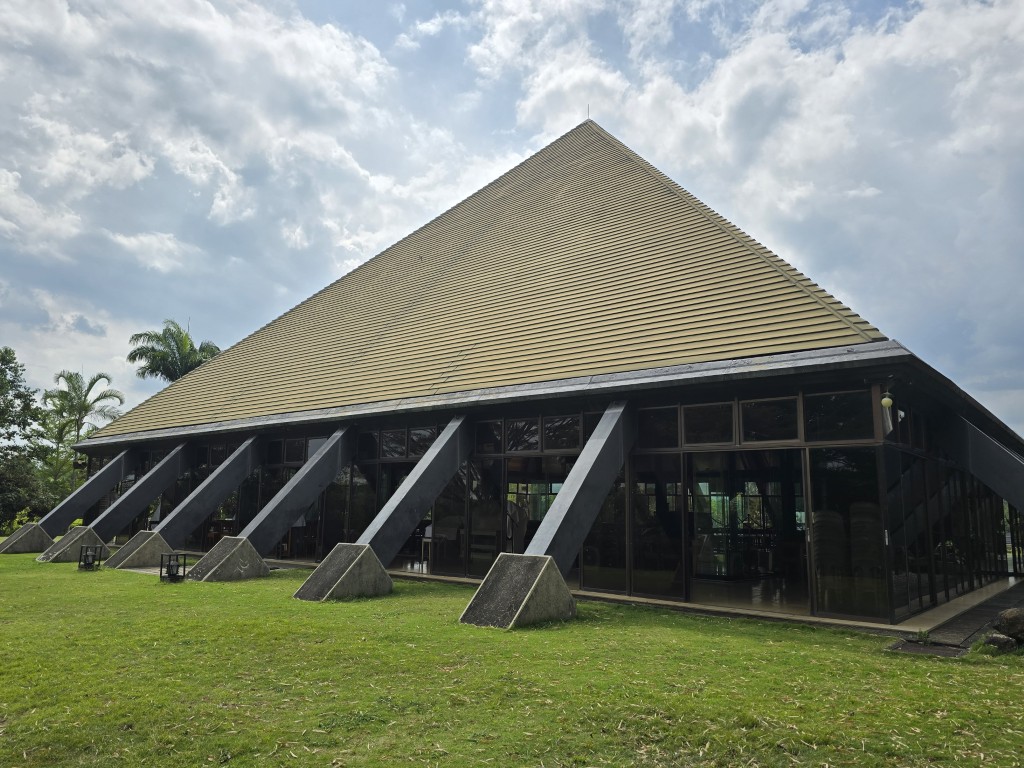
After our adventurous trip up the mountain ridges of RotyPeaks, we drove for 45 minutes from the town of Impasugong to the capital city of Malaybalay. We finally reached the abbey complex at around 01:20 PM. We were the only ones in the compound when we arrived, but we were welcomed in solemn awe by the iconic Abbey Church of the Transfiguration of the Lord.


The pyramidal Church of the Transfiguration.
Before the pyramidal church was built, the monastery had three smaller pyramids, which was a reference to what Peter said to Jesus during the Lord’s Transfiguration in Mt. Tabor. The three smaller pyramids were inaugurated on 06 August 1983, while the subsequent pyramidal church was dedicated on 06 August 1996, the Feast of the Transfiguration.
After six days Jesus took Peter, James, and John his brother, and led them up a high mountain by themselves; and he was transfigured before them; his face shone like the sun and his clothes became white as light. And behold, Moses and Elijah appeared to them, conversing with him.
Then Peter said to Jesus, “Lord, it is good that we are here. If you wish, I will make three tents here, one for you, one for Moses, and one for Elijah.”
Matthew 17:1–4
ORA
Upon entering the church, we were enamored not only by its aesthetic beauty but more importantly by its touching solemnity. The altar was a volcanic rock carved to be the perfectly immovable sacrificial table unto which the sacrifice of the Mass is offered. Seats were arranged in such a way that the altar is the core of the church building, in the same way that the Eucharist is the core of the life of the Church. At the overhead retablo is a replica of Our Lady of Montserrat, a homage to the patroness of the abbey in Spain which in turn became the patroness of the abbey in Manila.


The Queen of the Serrated Mountains. The replica of Our Lady of Montserrat, the altar and details of the roof of the church.
The high ceiling of the church allowed for natural air to flow such that it was cool inside despite the heat of the sun outside, making silent experiences with the divine comfortable. With the Benedictines spending eight hours in prayer—and eight hours of work, hence their motto Ora et Labora—contemplating the already unfathomable presence of God need not to be corporally insufferable.
We offered our personal silent prayers inside the church. As for me, I allowed myself to be absorbed by the blessed feeling of being in the presence of the image of Our Lady of Montserrat, in an abbey of the order founded by St. Benedict, grounded to my Benedictine upbringing. After our prayers, we proceeded in walking around the church grounds, appreciating monastic peace that is hard to find in this day and age. We then took our photos in front of the church, trying our best to be in our prim and proper selves lest we shatter the silence of the monks.


PAX. The monastic peace and silence of the abbey.


Contrary to what others think, no we are not postulants.


The four of us in our best behavior, until we cannot take it any longer!
LABORA
From the church, we took a little walk within the compound to get to the abbey gift and coffee shop. Apart from the spiritual enhancement that the abbey has to offer, it is equally popular for Monks’ Blend Premium Coffee. The coffee is a blend of arabica and robusta coffee; the arabica beans are sourced from local farmers, grown in the highlands of Mt. Kitanglad, while the robusta beans are grown by the monks themselves within the abbey land. Apart from the sustainable partnership that the monks create with the local community, growing, harvesting, roasting and grounding the coffee beans to the aromatic blend known to many fulfils the work part of their monastic witnessing to Christ and the life of the Church.


Abbey Cafe: where Monks’ Blend brew all day.


The abbey gift shop for souvenirs and pasalubong.
Since we were still full from our meal up in RotyPeaks, we no longer had room to try the offerings at the cafe, something that in hindsight, felt like a small regret. We did, however, linger long enough at the gift shop, where we picked up a handful of souvenirs and local food items. As for me, like a true Bedan drawn to anything Benedictine, I bought five pieces of the Medal of St. Benedict to give to my loved ones at home.
It was already 02:00 PM when we started our way to our next destination. It was only our second day in Northern Mindanao, and with five more still ahead, our visit to the Abbey of the Transfiguration seemed to offer something more than a pause in the itinerary. It gave the journey a kind of grounding—quiet, steady, and unspoken—so that what lay ahead would not merely be a collection of places seen, but an experience carried with a deeper sense of purpose.

As the abbey receded into the distance, its stillness seemed to follow us in ways not immediately apparent. The road stretched forward, as it always does, but there was a subtle shift in how it was taken; not with urgency, but with a kind of attentiveness learned, however briefly, from the hills. Perhaps that was the gift of the visit: not something left behind, but something that quietly remained.


Leave a Reply to renegadetravellerCancel reply