
Like most of the other provinces in the Philippines, Bukidnon did not start as a province of its own. Lumad tribes inhabited the present-day province, and those inhabiting the plateau were referred to as Bukidnon, which means either highlands or mountain dweller. When the Spaniards administratively divided Mindanao in 1850, Bukidnon was placed under Misamis. The entire area was referred to as Malaybalay back then, with the term Bukidnon used to refer to the people, not the place.
The provinces established by the Spaniards were further reorganized when the Americans came to the Philippines. In 1907, Malaybalay was carved out from Misamis, finally named Bukidnon, and was made a sub-province of the then newly created province of Agusan. Rancheria de Malaybalay was named as the capital of the sub-province. In 1917, Bukidnon was made a regular province alongside the creation of the Department of Mindanao and Sulu of the American colonial government.
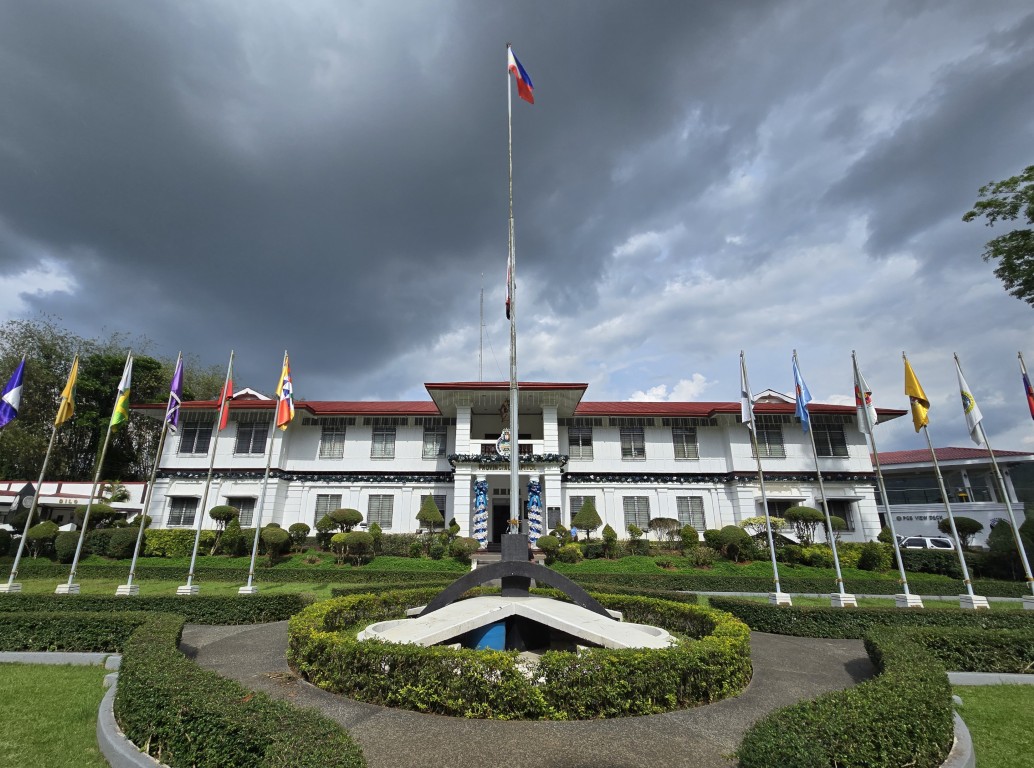
It was not until 1933 when Bukidnon had its formal capitol building. It was, however, damaged during World War II but was restored in 1946. In 2025, it was graced by the National Historical Commission of the Philippines with a historical marker, noting that it is one of the most exceptional capitol buildings in Mindanao that preserved its original neoclassical elements.


The neoclassical provincial capitol building of Bukidnon.
It took us only 20 minutes or so to go from one architectural wonder to another; from the Benedictine spiritual center of Bukidnon to its center of governance and power. In keeping up with what Bukidnon is generally known for, which is a green highland haven, the provincial capitol is tucked in an expansive complex surrounded by trees that keep the surroundings cool, providing a public space where people can spend time and hangout.
It was a working day, hence we opted not to enter the capitol building anymore. We just grabbed the opportunity to take photos of one another with the main building of the capitol as our background.


The ultimate proof of being in a Philippine province: a photo at the capitol.
After taking our photos in front of the capitol building, we took a very short walk towards its rear where a view deck and boardwalk is located. The deck, which was a new addition to the capitol complex that was opened in 2025, provided a decent view of the trees below, intended to promote eco-tourism and environmental preservation, among others. It also had an al fresco cafe for those who would want to have a dose of caffeine while chilling from a nice overlooking height.


The Provincial Government of Bukidnon View Deck and Boardwalk.


A view of green from the deck.


Reflection.

We started heading back to the car when we were done taking our souvenir photos. Along the way back to where we parked, we got to appreciate some other details on the ground fronting the capitol: the flags of every municipality of Bukidnon and the Hall of Justice that sits next to the main capitol building.


The municipal flags and the Hall of Justice flanking the capitol.
As we walked under the canopy of trees, we cannot help but reminisce our visit to Pangasinan Provincial Capitol, especially since that we were with Clark and Guada who are both from that northern province, and since the former served as our guide and host during our visit. While the capitol of Pangasinan is imposing in both its size and intricate architecture, the capitol of Bukidnon has its own charm unique to the province unto which and for which it stands. One is the guardian of the gulf, the other the guardian of the highlands. That is the thing about provincial capitols. Apart from being the center of governance of a particular province, they the story not only of their location but also of the development of the history, tradition and culture of the people. They are not merely silent witnesses to the unfolding of time—they are silent storytellers.


The trees providing cool shade to those who spend time on the capitol grounds.
The provincial capitol of Bukidnon would be our last stop for the day in the province. It would still take at least a couple of hours before we were back in Cagayan de Oro. While our Bukidnon adventures had been a delight, we aimed to return to CDO before nightfall so that we could settle back in our accommodation, prepare for the next day, then rest. The following morning would come early again, and we would find ourselves drawn back to Bukidnon once more.
As we made our way down from the highlands, there was a quiet sense that the day had not quite ended, only paused. The road ahead led away from Bukidnon, but not entirely from what it had given. There are places that remain behind, and there are those that travel with you. In that slow descent toward the city, it became clear which kind Bukidnon was.


Leave a Reply