
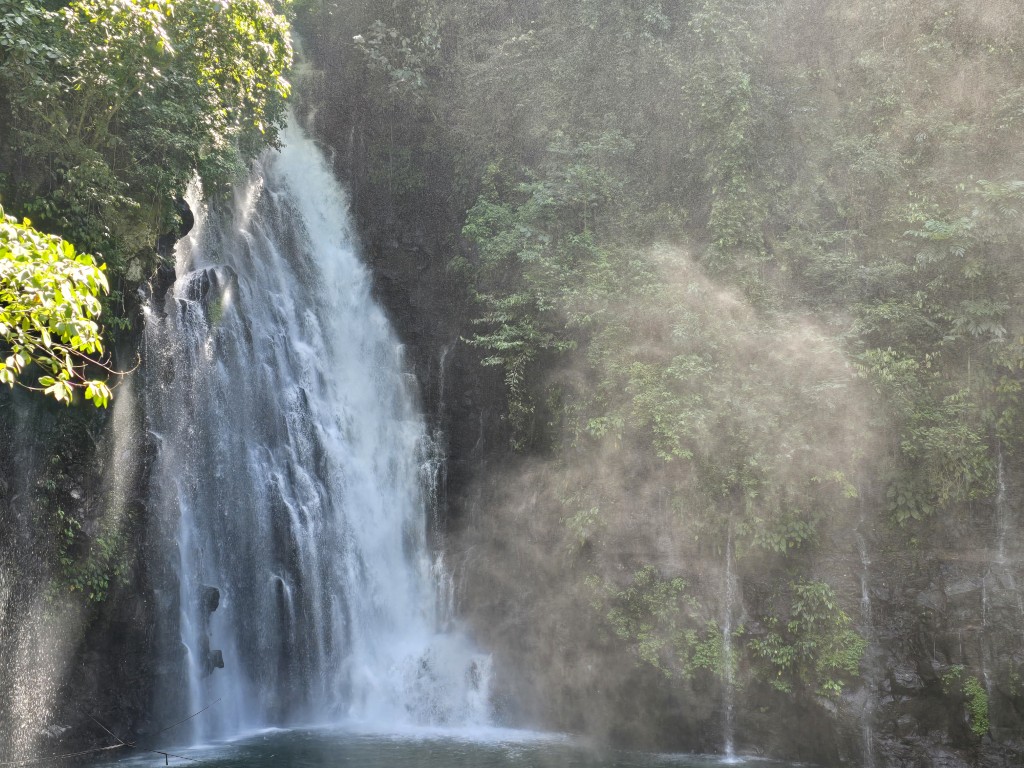
We in Renegade Junctures do not fall short of waterfalls in our bucket list. From our earliest expeditions to Tangadan Falls in La Union, to the technical backcountry chases through the mud of Mt. Romelo, all the way to the soaring majesty of Quirino’s Ganano Falls and the terraced, crowning jewel of Abra’s Kaparkan Falls, standing before those plunging currents always yields a distinct sense of personal triumph. For the most part, waterfalls are inherently reclusive, masking themselves from plain sight behind dense forests and steep, mountainous terrain. Yet even when modern infrastructure strips away the wilderness trial—as is the case with the paved entries to Sulu’s Tambuang Falls, Basilan’s Bulingan Falls, or our recent crossings to Misamis Oriental’s Sinulom Falls and Camiguin’s Katibawasan Falls—crossing that threshold still commands a unique fulfillment, offering an inexplicable lift to the traveling spirit.
After our trip to Marawi City, which was a sobering journey back in time to its darkest history yet, a restorative release is exactly what we needed. Thankfully, our next destination was Tinago Falls.


Various signages of Sanctuary at Tinago.
True to its name tinago, which translates literally to hidden across most Philippine languages, the falls does not merely sit concealed within a physical fissure of the earth—literally around 500 steps of stairs down concealed. Its very etymology is anchored to a sorrowful local legend of being stashed away from prying eyes. Folklore has it that a long time ago, a powerful Sultan and his wife ruled the lands with absolute authority. While the Sultan’s wife was bearing their child, an enchantress disguised as a destitute beggar approached her, pleading for alms. Rebuffed and turned away by the proud royal, the enchantress left a bitter, vengeful curse in her wake: the unborn child would be afflicted with a countenance of shocking ugliness.
When the child was born, the curse manifested with cruel precision. Ashamed of her appearance, the royal couple named the infant Tin-ag, meaning hidden face, and banished her to the isolation of a deep cave, entirely secluded from public view. Years later, as a young woman, Tin-ag finally managed to escape her subterranean prison, only to find herself fiercely reviled and shunned by the kingdom’s subjects. Witnessing the profound misery wrought by her own malice, the enchantress was ultimately moved to pity. In an act of sudden redemption, she offered to reshape the young woman’s tragic form into a creation of sublime, eternal beauty, transforming Tin-ag into the cascading, magnificent curtains of the waterfall itself.


The challenging 500–step stairs down to the falls.
It is a poignant origin story, but the theme of hidden depths shifts beautifully from myth into material geography. Despite its administrative placement within the borders of Lanao del Norte, Tinago Falls remains indissolubly bound to the high country of the Maranao. The immense torrents that plunge down its 73.15–meter precipice are fed entirely by the Agus River, the singular, mythic outlet carved out by the winds to carry the overflow of the great inland sea of Lake Lanao.
Reaching the basin of the falls required a deliberate, vertical journey down into the humid throat of the ravine. Currently under private management and operated under the moniker Sanctuary at Tinago, this natural wonder has been thoughtfully retrofitted to accommodate sizeable crowds, offering concrete tables and benches where families and travelers can gather for shared meals. The commercial infrastructure though does nothing to diminish the wild majesty of the chasm. In truth, the resort space feels expansive only because the waterfall itself is so profoundly colossal, a thunderous curtain of white water whose immense acoustic roar paradoxically induces deep tranquility rather than chaotic noise.
Standing at the foot of the canyon sparked a sudden, profound topographical epiphany. Back along the shores of Marawi City, the lake had appeared deceptively flat, tranquil, and level with our immediate surroundings. It was only there, standing face-to-face with the cascade, witnessing the sheer kinetic fury of the water dropping violently into the ravine, that the true geometry of the landscape laid itself bare: we had been traveling along a massive, elevated plateau all along, suspended high above the coastal plains.


Off all things hidden, this one should never be.


One great irony: the noise that calms.
Merely marveling at this magnificent force from a safe distance was never going to be enough, at least not for Ran. Together with the rest of the Aura Adventures crew, he immediately braved the basin to submerge himself in the rushing, glacial currents. The group even boarded a bamboo raft, navigating directly beneath the thunderous, crushing downpour of the main curtain. For my part, tracking their movements through the camera lens of my phone from the rocky perimeter was more than enough. My mind was still heavily occupied with the gravity and ghosts of Ground Zero, carrying a wealth of history that desperately needed space to settle. Standing solitary in the heart of that chasm, entirely enveloped by a freezing veil of mist and the absolute, consuming roar of the water, was precisely the sanctuary I required at that moment.


The crew enjoying the water rush of Tinago.


Candid shot. Ran taking a break from swimming on a huge rock.


Children climbing to and jumping off from the side walls of the falls.
Our Tinago Falls experience lasted a little over two hours—a profound suspension of time that remained entirely captivating right up until the moment we had to conquer the grueling 500–step ascent back to the resort entrance. In introspect, the true weight of the chasm lay in its beautiful irony. We had deliberately journeyed to uncover a place whose very name means hidden, and we did so after confronting the haunting stillness of Marawi. It stood as the absolute antithesis to the landscape we left behind: a primeval, thunderous roar whose necessary noise rose up to decisively shatter the echoing silence within.
We were already inching our way toward the end of our sixth day in Northern Mindanao. From marveling at the raw wonders of nature to reflecting on the heavy complexities of human history, these explorations had yielded a far deeper understanding of how the region has developed culturally, and how its people continue to safeguard both their landscape and their identity. We had traced ancestral waters from high-altitude plateaus down into the roaring depths of hidden chasms, carrying the realization that the true soul of this land lies not in its administrative lines, but in its unyielding resilience.
This profundity did not merely settle as passive knowledge; it became the very lens through which we watched the highway en route to our next destination. We realized then that the true renegade path isn’t just about charting remote geographical crossroads, but about allowing those crossroads to permanently alter your interior world.


Leave a Reply