
It had been quite a while since we in Renegade Junctures had our last family expedition. Eight months had passed since our journey through Bicolandia in September 2025, making a reunion on the road long overdue. The opportunity finally presented itself with my mother’s birthday, a milestone that called for a journey northward to Pampanga, the province where the maternal roots of our family run deep.
Our itinerary for Mama’s birthday drive was intentionally unhurried, guiding us past familiar provincial grids. We first made our way to Mexico, our maternal hometown, drifting along quiet roads until we settled in for a hearty lunch at a local restaurant. It was only over our meal that we loosely mapped out the rest of the day, agreeing on a delightfully straightforward route: a church visit, a quick stop at the public market for authentic Kapampangan longganisa, and a relaxed afternoon spent together at a nearby theme park.


A hearty lunch in Mexico, Pampanga.
After our meal, we traced our route back past San Fernando, driving deeper into the heart of Guagua. As we navigated the quiet, low-slung suburban sprawl of the area, there was little on the surface to suggest that we were approaching a gateway to a celestial empire: the St. James the Apostle Parish Church, more popularly known as the Betis Church.
Betis was an independent municipality in Pampanga long before it was absorbed into the commercial hub of neighboring Guagua in 1904, during the early American colonial period. Named by early Spanish chroniclers after Hispania Baetica, the ancient Roman province defined by the great Guadalquivir River in southern Spain, the enclave once possessed its own municipal autonomy. To walk the grounds of Betis Church today is to stand before the last fortress of that lost civic identity. It is a monument that refuses to forget what the town once was, serving as the ultimate repository for a centuries-old heritage that outlasted the changing boundaries of maps.


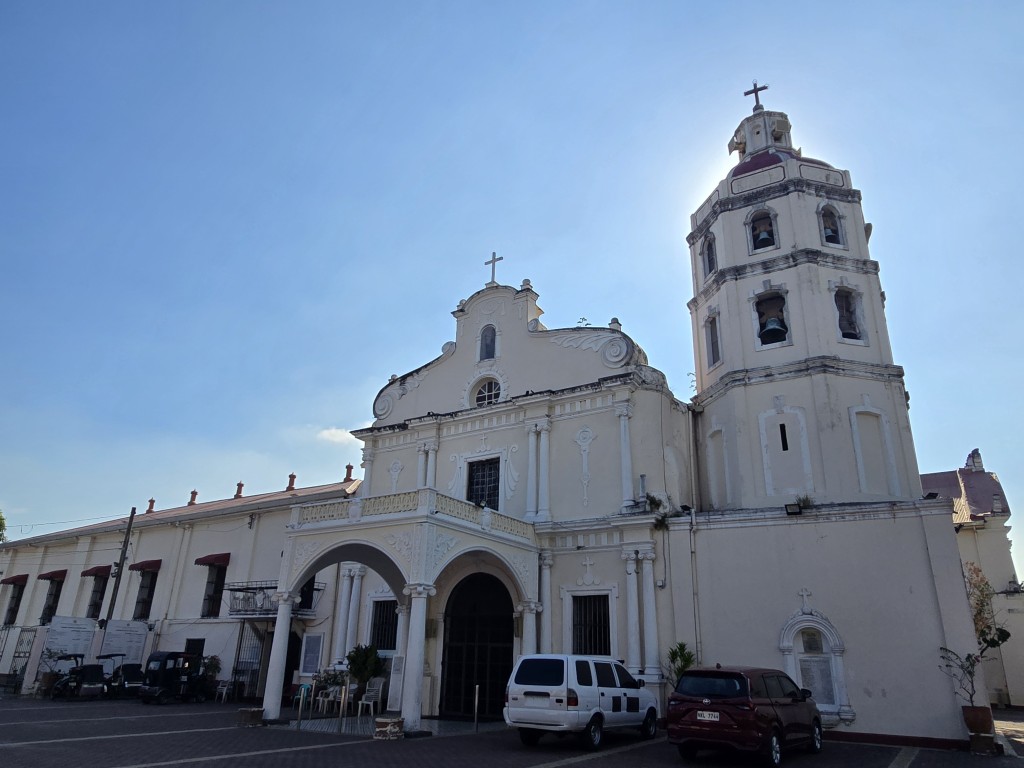
The modest facade of the Betis Church makes the unassuming clueless of the grandeur within.
The exterior of Betis Church is an exercise in architectural modesty. Its weathered, off-white facade and octagonal bell tower blend seamlessly into the provincial landscape, offering no structural hint of the sheer weight of art waiting within. Finding the gate covering the massive wooden main doors closed, we turned to the side entrance, passing through a quiet parish hall that houses a small gift shop and a historical exhibition; a modest vestibule that serves as a fitting prologue before stepping into the sanctuary itself.

Crossing the side threshold forces an immediate, involuntary shift of the eyes upward. In a single step, the mundane grid of the modern roadside is completely extinguished, replaced by a soaring, golden-and-pink Baroque universe that feels less like a building and more like a living, breathing canvas suspended in time.
First established in 1607, Betis Church was initially constructed from timber and thatch, leaving it vulnerable to the fires that repeatedly swept through the early settlement. It was not until 1770 that the sanctuary was permanently rebuilt in heavy stone and masonry, creating a resilient shell capable of withstanding both time and flame. Over the centuries that followed, the structure underwent a continuous succession of restorations, reaching its artistic zenith in 1939 when Father Santiago Blanco, OSA, the parish’s last Spanish Augustinian friar, spearheaded an ambitious campaign to embellish the interior. It is that very vision from nearly a century ago, brought to life by the hands of master local artisans, that continues to mesmerize pilgrims and travelers the moment they step through its doors.


The painted side walls of the church.


Divine beauty in human art. The painted ceilings of the church, and its well-preserved wooden floors.
While the rest of the family continued toward the sanctuary and the grand arch of the apse, I quietly detached myself and made my way toward the narthex, seeking out the baptistry. The chamber opened into a richly detailed sanctuary of its own, dominated by an ornate painting of Christ’s baptism in the Jordan by St. John the Baptist. Beneath the canvas rests a quiet repository housing a reliquary containing a bone relic of St. James the Greater, the parish’s titular patron. Standing before the glass in the stillness of the vestibule, I paused for a silent prayer before turning to rejoin the others.


The Baptistry.


Ex ossibus relic of St. James the Greater.
I turned to rejoin the family in the main nave. As I walked, my eyes—and inevitably, my camera—were drawn upward to the painted sky stretching across the vault. The grand murals that line the interior are attributed to local master artists Isidoro Soto and Macario Ligon, who were commissioned during the extensive 1939 beautification of the sanctuary. Decades later, when time and humidity demanded a painstaking restoration between the 1970s and 1980s, the monumental task fell to Victor Ramos, himself a nephew and protege of Macario Ligon. It stands as a remarkable testament to local stewardship, ensuring that the visual legacy of the church remained in the hands of the very lineage that created it.


Samaritana et Pastor Bonus.


Images and paintings featuring the Blessed Virgin Mary.
As is characteristic of cruciform church architecture, the four major piers supporting the central dome are anchored by pendentives adorned with portraits of the Four Evangelists. Above them, the dome unfolds into a sprawling celestial mural, bathed in soft natural light filtering through the window panels of the octagonal cupola. Gazing upward, the optical illusion is spellbinding: the solid ceiling appears to dissolve into an open sky, revealing a chorus of angels and saints poised in a moment of divine welcome.


The Four Evangelists.


A view of Heaven. The ornate interior of the dome of the church.
Directly beneath this painted dome lies the heart of the church: the sacred sanctuary where human artistry, regional history, and spiritual devotion seamlessly converge at a single focal point.


Sanctus Iacobus Maior. The ornate retablo of the church with the antique image of St. James the Greater at the middle.
Flanked by an ambo and altar designed to mirror the sanctuary’s intricate aesthetic, the majestic retablo mayor dominates the holy of holies. Hand-carved with the hyper-detailed woodwork for which Betis is famous, the multi-tiered altarpiece enshrines antique holy statues, with the image of St. James the Greater enthroned at its center. To the epistle side of the sanctuary rests an exquisite antique crucifix, its deeply expressive carving serving as a quiet testament to salvation realized through generational craft.


A beautiful sign of salvation.
Grateful for the rare privilege of traveling together to celebrate Mama’s birthday in a place so deeply tied to our maternal heritage, we lingered in the stillness of the chancel. Standing in that sacred space, surrounded by centuries of painted heaven and carved stone, we paused to capture a few family photographs to mark the milestone.


Our family, united by journey and in faith.
Beyond the sanctuary steps, some of us ascended the historic carved pulpit elevated above the nave. Following the liturgical reforms of the Second Vatican Council and the widespread adoption of modern public address systems, the elevated wooden perches gradually fell into disuse. Standing atop a structure that had endured for centuries, where friars in a bygone era once stood to proclaim the Gospel and address the town below, offered a rare, tactile connection to the church’s living history.


The well-preserved pulpit of the church.
Concluding our visit inside the sanctuary, we exited through the wooden doors of the north transept. Stepping out of the dimly lit, gilded interior, we emerged into the quiet courtyard of the parish convent garden, where the greenery provided a refreshing, alternative perspective of the church’s weathered exterior. Looking at the church as we walked along was like bidding it farewell, hoping that soon enough, we will see it again.


Part of the cloister of the church.
It was already past 04:00 PM when we took to the road once more, bound for the San Fernando City Public Market. We headed directly toward Mama’s favorite stall, a trusted corner long famed for authentic Pampanga longganisa. Widely celebrated as the country’s culinary capital, the province takes distinct pride in its cured meats, with its local sausage standing among its most popular delicacies. Pampanga’s version is known as hamonado longganisa, defined by a rich, sweet flavor profile that stands in stark contrast to the sharp, garlicky, and peppery variants from localities like Vigan, Lucban, and Calumpit. Being a native Kapampangan, Mama knew precisely which stall held the original, uncompromised recipes, guiding us straight to the best native strings in the market.


Strings of native Kapampangan longganisa.
After securing our strings of longganisa, we made our way toward a nearby amusement park adjacent to a prominent shopping center, giving the children space to unwind and play. For us adults, it offered a gentle, unhurried close to a full day spent on the open road. It felt like the completing arc of a single, continuous circle: history, culture, and faith at Betis Church; ancestral culinary identity at the public market; and quiet, modern family leisure to end the evening. It was precisely this tapestry of contrasting experiences that gave the day its harmony, a seamless continuum within a single province that offered us an entire spectrum of life in a matter of hours.


Ran with the kids.
As the night settled over the amusement park, we were reminded that the spirit of exploration is not always found in far-flung wildernesses or grueling technical climbs. Sometimes, the most meaningful renegade juncture is a simple, unhurried return to one’s roots—celebrating Mama’s birthday in the provincial heartland where her maternal lineage began. Pampanga had offered us an unbroken circle in a matter of hours: sacred art carved in timber, ancestral flavors wrapped in market strings, and the simple, enduring warmth of family gathered in the dusk. It was a quiet homecoming that proved the sweetest journeys are often those that bring us back to where our own history started.


Leave a Reply