
The Americans occupied the Philippines for 40 years, from the promulgation of the Treaty of Paris in 1898 until the Philippine Independence in 1946. While they were successful in eventually occupying the archipelago, it was not without considerable extent of resistance that reached its peak during the Philippine–American War. It was during the extensive three-year war between the Philippines and the United States when the Battle of Cagayan de Misamis occurred in April 1900. That battle resulted to the retreat of the Filipino forces.
It was not always a defeat though. A couple of months later, in June 1900, the 40th Infantry Regiment of the United States launched an assault against the Filipinos stationed in Macahambus Hill. The Filipinos, armed with rifles, a couple of Spanish canons and superior knowledge of the land, was able to repel the attack with a decisive victory. While the victory at Macahambus Hill did not turn the tide of war as the Americans will ultimately conquer the Philippines, it stood as an immortal testament to Filipino bravery, strategy and ingenuity.
On hindsight, treading upon the roads of Cagayan de Oro was a retracing of the path of history both in time and space, the same perception by which we experienced our visit to the CDO City Museum. From the museum, it took around 24 minutes before we reached the hill that silently speaks of victory.


Historical markers commemorating the historical Battle of Macahambus.
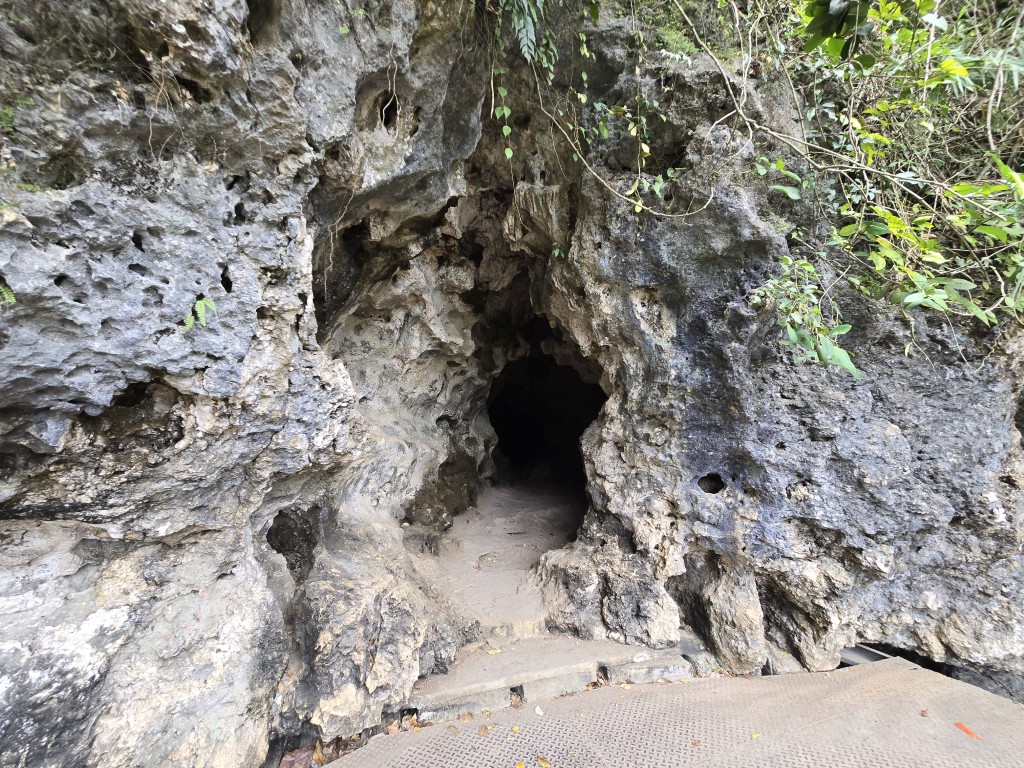
Macahambus Cave is conveniently located by the roadside, along CDO–Airport–Bukidnon Road. We had to park the car on the opposite side of the road where the cave was where it would be safe and where it would not obstruct other vehicles. We entered the cave, but just a few steps into the hollow and we were greeted by extreme darkness that not even our phone torches could dispel. We knew that the cave cuts through the hill and that it opens at the other end to the Macahambus Gorge, but without a guide to navigate the darkness, we did not attempt to go deeper.


The entrance of the cave fronting the road.


Point-and-shoot in the darkness, flash on.
This would not be Renegade Junctures though if we gave up just because we cannot navigate through the darkness. We went out of the cave and turned right, walked a little with Ran taking the lead, until he eventually found the pathway that leads to the other end of the cave facing the Cagayan de Oro River.


The hillside pathway that goes around the cave.


There was a pathway that goes further down, to where the Macahambus Gorge is located. The stairs leading down, however, did not seem to be in reliably safe condition. Given that there were only the two of us, we did not risk it. Besides, the fact that we were able to navigate to the other end of the cave by going around it without a guide was more than enough. We were satisfied with the cool verdant surroundings above us and the sound of the gushing water from below.


Macahambus: check!
As if to be in a place once defended by our forefathers against the colonizers was not awe-inspiring enough, we were also able to bring the experience a notch higher by being there on our own, figuring things out without a guide. We did not expect that we would have an adventure in Cagayan de Oro similar to the one we had in Apayao, and it is not as if we were complaining. Fact of the matter, things unfolded just the way we wanted it to: going back in history while chartering new adventures. Everything, just on our first day in Northern Mindanao, and we were not even finished yet.

We returned to the car and set ourselves to our next two destinations, which would be our last next two. To us, it would be the perfect feather to put on the cap of our first day in Northern Mindanao. Faith, history, adventures—what else could we ask for?
One more. Nature.


Leave a Reply