
Muhammad Dipatuan Kudarat was, by traditional accounts, an unexpected sovereign. When he ascended to the throne of the Sultanate of Maguindanao around 1616, his rise faced stiff resistance from the datus of Lanao, a friction that ultimately resulted in the formalization of the Confederate States of Lanao. Despite this territorial and political secession, the two polities did not sever ties. While Lanao carried on through its four principal states under their respective leaders and Maguindanao forged ahead under Sultan Kudarat, they maintained a vital alliance rooted in a common heritage and shared beliefs, laying the groundwork for an era that would come to be remembered as the Golden Age of Mindanao.
Sultan Kudarat is highly regarded as the greatest Sultan of Maguindanao and the most powerful Sultan of Mindanao. During the height of the Spanish conquests, he successfully repelled colonizers from both his own sultanate and the allied Maranao territories, forcing foreign invaders to retreat and keeping his domain secure. Alongside his formidable military reputation though, he was a pragmatic statesman. In 1645, he forged a treaty with Spanish Governor–General Diego Fajardo Chacon that granted Spanish missionaries access to minister to Christian communities in Mindanao, authorized the construction of a church, and opened vital trade routes within his domains. Beyond the Spanish frontier, Kudarat also maintained extensive international trade networks, the most notable of which were with the Dutch and the Chinese.
Sultan Kudarat’s greatness has been etched deeply into the Maguindanon identity, and his legacy endures. So profound is this reverence that in 1973, 302 years after his passing, a vast tract of his former domain was carved out from the historical Empire Province of Cotabato to officially become his namesake province of Sultan Kudarat.


The greatest and most powerful. Sultan Muhammad Dipatuan Kudarat.
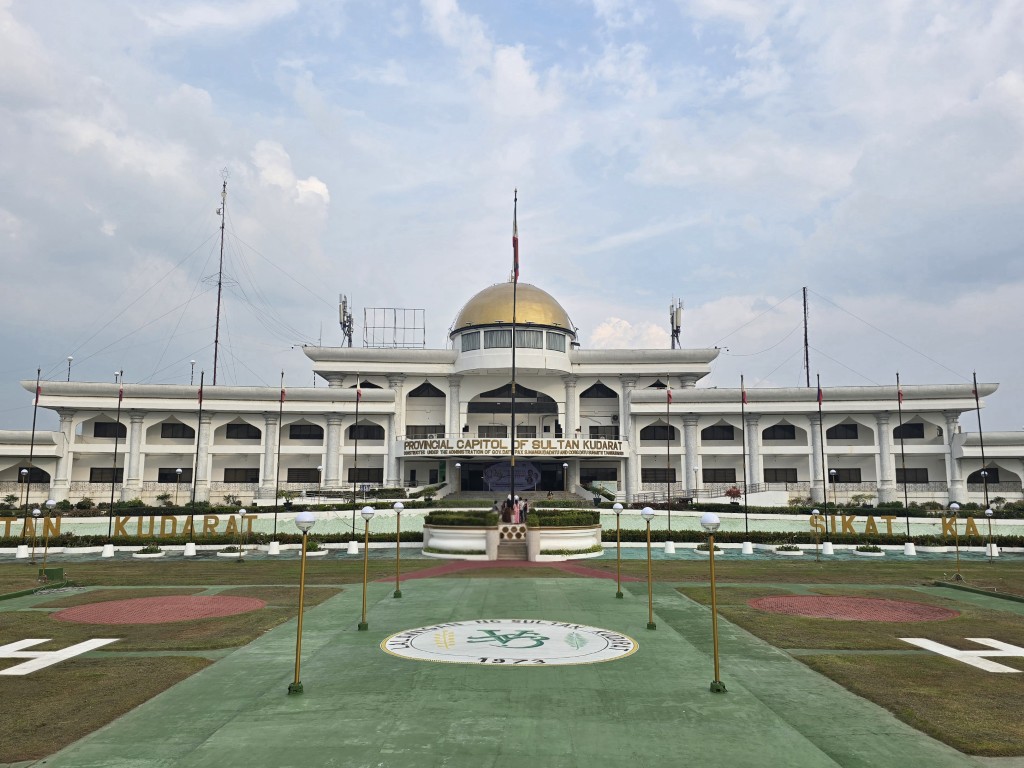
It took over an hour from the Pangadilan Falls and Rock Formation before we finally reached the administrative heart of Sultan Kudarat. The provincial capitol is every bit as monumental as one would expect from a territory named after a magnanimous sovereign of a distant past. Constructed over a span of six years from 2000 to 2006, the massive building commands a sprawling property in the capital municipality of Isulan. Defined by its striking Moro and Islamic-inspired architecture, the edifice serves as a creative, structural homage to the great ruler whose legacy and name have been permanently lent to the province.


The Renegade Duo in the land of the Sultan.

A closer view of the provincial capitol.


Making each moment count in our renegade lives.
The interior of the capitol building is every bit as magnificent as its imposing facade. A circular fountain anchors the main lobby, sharing the space with a curated exhibition of historical artifacts. Moving deeper into the hall, a sweeping grand staircase guides visitors toward the upper administrative floors. The architecture then inevitably commands attention upward, drawing the eye into the cavernous interior of the dome where an intricately designed chandelier hangs suspended over the civic space.


The interior of the provincial capitol.
Following our exploration of the provincial capitol, a brief drive to the neighboring compound brought us face-to-face with another civic marvel, the Provincial Hospital of Sultan Kudarat.


The Sultan Kudarat Provincial Hospital.
Striking in its Moorish design and distinct green-and-white palette, the four-story facility was formally inaugurated in 2021. Its significance extends far beyond aesthetic grandeur though. Equipped with a 399–bed capacity and state-of-the-art medical facilities, it is widely celebrated as a pioneer of the zero-billing policy in the Philippines, proving that its profound commitment to public welfare easily matches the beauty of its monumental exterior.
While we naturally refrained from wandering inside an active medical institution, we made sure to spend a few moments capturing the commanding elegance of its facade.


In front of the provincial hospital.
It was already a quarter to 05:00 PM when we left the provincial hospital. That would be our last stop in the province of Sultan Kudarat for the time being. It would still be more than a couple of hours of driving before we reached our accommodation in Cotabato City, signaling that our first day in Soccsksargen was steadily coming to a close.
As the sky deepened outside the tinted windows of our service vehicle, it served as a quiet reminder of how time dilates on the road. Just earlier that day, we were navigating the urban sprawl of Metro Manila, waiting for our flight to Mindanao. Now, as the sun began to set, we were rolling through the far-flung stretches of the south, traveling deeper into the heartland of a place I once thought I would never visit, yet find myself continually coming back to for more.


Leave a Reply