
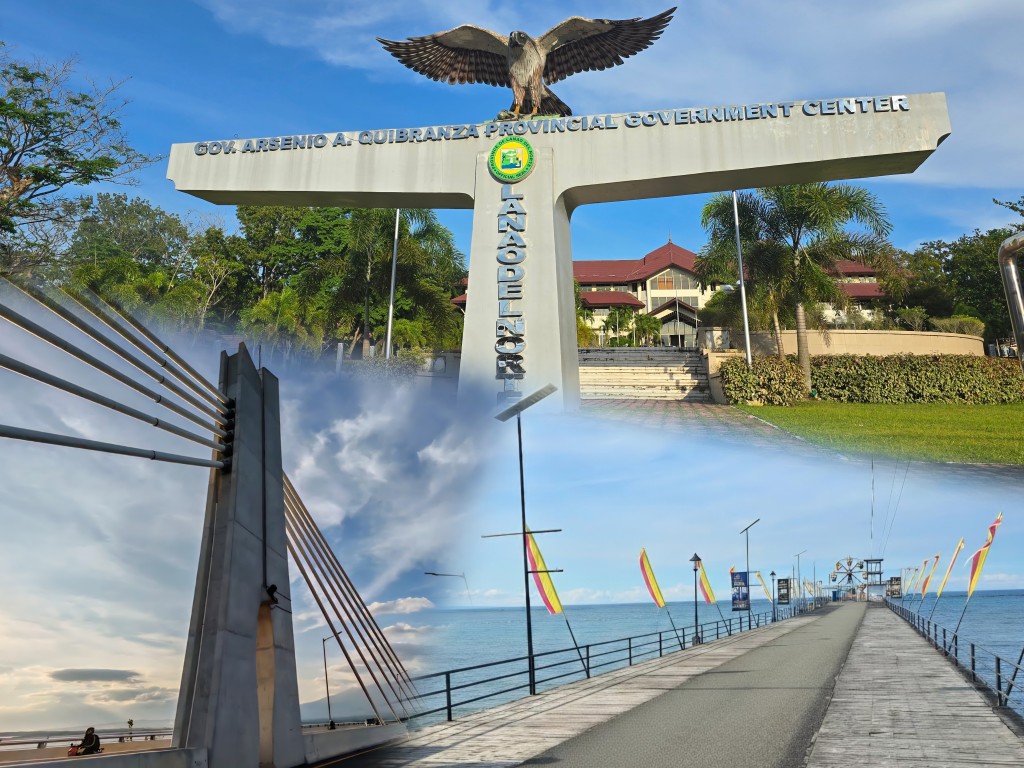
Known as the Land of Beauty and Bounty, the province of Lanao del Norte has gone far beyond diverse landscapes and cultural harmony on one hand, and agricultural abundance and marine wealth on the other. In its own right, it can likewise be considered the land of lengths and spans. Two pieces of its infrastructure are particularly notable, not just in the region but in the country at large. They don’t just boast impressive physical dimensions; they play vital roles in the everyday Lanaonense way of life.
After our challenging yet refreshing trip to Tinago Falls, it was time to push our journey to its final stretch—a literal stretch
Leaving behind the thunderous roar of the highlands, we headed straight for the sea. Along the shores of Iligan Bay, in the town of Kauswagan, lies the longest boardwalk in the Philippines. Stretching 400 meters out into the shallows, this massive promenade anchors the Kauswagan Longest Boardwalk and Amusement Park complex. It is a perfect spot for families and friends to relax, chill, and unwind.


Kauswagan Longest Boardwalk and Amusement Park.


Scenic sea surrounding the Kauswagan Boardwalk.


Basking under the afternoon sun.
Initially intended to serve as a commercial pier when first constructed in the 1980s, the shallow depth of the bay made it impossible for large vessels to dock, forcing planners to abandon the project. Instead, it was repurposed as a domestic fish landing facility, which eventually evolved into a scenic local hangout. Years later, the local government unit of Kauswagan transformed the massive concrete pier into an eco-tourism hub, adding an amusement park on it that opened to the public in 2022.
The rides were closed when we arrived, which was entirely understandable given it was only around 03:00 PM. We just hence decided to just walk all the way out to the end of the boardwalk to appreciate the sea breeze and the sweeping coastal views. Towards the end of the pier, a staircase led down beneath the massive concrete slabs. There wasn’t much to see down there except for clusters of barnacles clinging tightly to the cement posts, but it provided a uniquely industrial, shadowed backdrop for photos.


The waters of Iligan Bay.


Beneath the planks, on top of the sea.


May hindi pulis sa ilalim ng tulay.
With the boardwalk thoroughly explored, we loaded back into the vehicle and headed toward the provincial capitol of Lanao del Norte for a rapid-fire pitstop. In our case, a pitstop meant picture-taking.
When the historical province of Lanao was partitioned into Lanao del Norte and Lanao del Sur in 1959, Iligan City initially served as the designated capital of the north. However, in 1977, a presidential decree officially transferred the capital seat to the municipality of Tubod after Iligan was declared a highly urbanized city. By October 1984, the provincial government officially opened the present Provincial Capitol Building inside the expansive Governor Arsenio A. Quibranza Provincial Government Center.
We didn’t have time to walk up to the main capitol building itself. All we managed was a quick snapshot from a distance. We did, however, score a few photos right in front of the government center’s prominent roadside signage. It was a classic, quick road-trip stop, after all.


The main capitol building of Lanao del Norte from a distance.


The Governor Arsenio A. Quibranza Provincial Government Center signage.


Wishing to travel like an eagle: soaring high, majestic and free.
The absolute crown jewel of our coastal run, however, and the ultimate definition of a span, awaited us just a few minutes down the highway: the monumental Panguil Bay Bridge.
For decades, crossing the waters between Tubod and Tangub City in Misamis Occidental meant committing to a slow, time-consuming ferry ride or enduring a massive, hours-long overland detour around the rim of the bay. The opening of the sweeping architectural marvel in 2024 completely rewrote the geography of Northern Mindanao. Spanning 3.17 kilometers across the water, it stands proudly as the second longest water-spanning bridge in the Philippines, connecting two provinces with a singular, seamless ribbon of concrete and steel.
Driving onto the bridge just as twilight began to bleed across the horizon was an incredible experience. The windows were down, the humid coastal breeze filled the car, and the vast expanse of Panguil Bay unfolded on either side of us.


The towering columns of Panguil Bay Bridge.
Driving on the bridge, of course, was not the complete experience. Our driver parked the vehicle on the side of the bridge, and we almost instantly disembarked for an exhilarating photo ops. We cannot stop the rushing traffic, so we did everything with utmost care, and quickly.


In the midst of gushing wind and rushing cars, standing on a marvelous infrastructure.


Panguil Bay as seen from the bridge.
Crossing the modern giant was the perfect final juncture for our sixth day on the road. We had started our morning surrounded by the heavy silence of Marawi, found our necessary noise in the crashing mists of Tinago, walked the planks of Kauswagan, and paid our quick respects to the capital in Tubod. Undoubtedly, it was a packed day.

Watching the distant lights of Misamis Occidental flicker to life across the water felt like watching our next chapter approach in real time. Suspended high above the bay on an epic mega-structure, we left Lanao del Norte completely behind in our rearview mirror, coasting smoothly over the water into a brand-new province as the night finally set in.


Leave a Reply